
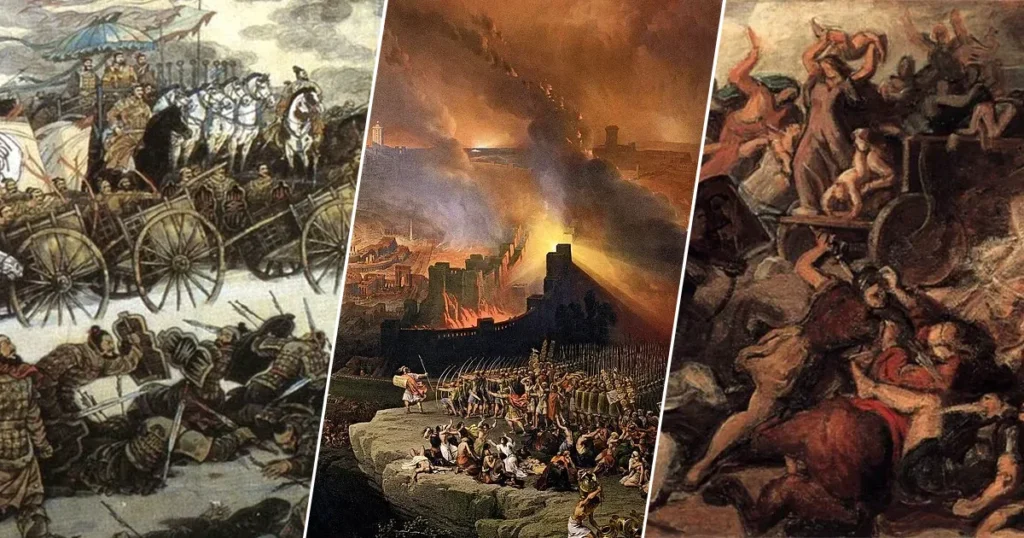
As I pondered about the “10 Oldest Historical Battles That Changed the Course of History,” I realized I had only a surface-level understanding of such pivotal moments. I truly wanted insights from a global perspective, avoiding the typical Western narrative. Curiosity sparked, I reached for my mobile phone, unlocked it, and opened the AI app to dive into a diverse array of historical sources from around the world.
“So I asked the AI: What are the top 7 entities regarding this subject, which are considered the best Oldest Historical Battles that I absolutely must know from a global perspective?”
“This topic offers an enriching exploration of pivotal conflicts throughout history, and I promise to provide you with a globally accurate, multi-sourced, and strictly unbiased list.”
The 10 Oldest Historical Battles That Changed the Course of History
1. The Battle of Megiddo (c. 1457 BC)
The Battle of Megiddo took place in ancient Canaan (Historical Palestine) and marked an essential victory for Pharaoh Thutmose III of Egypt. This battle represents one of the first recorded military campaigns, showcasing strategic troop movement and the use of diverse warfare techniques. Its significance lies in establishing Egypt’s dominance in the region, influencing future power dynamics among neighboring states.
2. The Battle of Kadesh (c. 1274 BC)
Fought between the Egyptians under Ramses II and the Hittites (Modern Turkey), the Battle of Kadesh is often recognized for its scale and the use of chariots. What makes this battle important is not just its outcome—a stalemate—but the subsequent peace treaty that led to one of the earliest recorded alliances. This event highlighted a sophisticated understanding of diplomacy in the ancient world.
3. The Battle of Guagamela (331 BC)
The Battle of Guagamela, near present-day Iraq, saw Alexander the Great face off against Darius III of Persia. This battle was crucial as it led to the fall of the Persian Empire and the spread of Hellenistic culture throughout Asia. The tactical innovations used by Alexander not only influenced military strategies but also ushered in significant cultural exchanges across regions.
4. The Battle of Zama (202 BC)
The Battle of Zama, fought near modern-day Tunisia, was a decisive victory for Roman general Scipio Africanus over Hannibal of Carthage during the Second Punic War. The outcome transformed Rome into a dominant Mediterranean power, signaling a shift in the balance of power in Europe and North Africa. This battle set the stage for the expansion of Roman influence in the ancient world.
5. The Battle of Al-Qadisiyyah (636 AD)
This battle marked a significant encounter between the Muslim Arab forces and the Sassanian Empire (Modern Iran). The victory at Al-Qadisiyyah opened the gates for the rapid spread of Islam and reshaped the religious, cultural, and political landscape of the Middle East. It illustrated how religious movements could intertwine with military conquests to create lasting changes.
6. The Battle of Talas (751 AD)
The Battle of Talas, occurring in present-day Kyrgyzstan, was fought between the Abbasid Caliphate and the Tang Dynasty of China. This battle is notable for the introduction of paper-making technology from China to the Arab world. Its repercussions extended beyond the battlefield, influencing education and culture, ultimately reaching Europe centuries later.
7. The Battle of Hattin (1187 AD)
The Battle of Hattin was pivotal in the Crusades, where Saladin’s forces defeated the Crusader states close to present-day Israel. This victory led to the Muslim reconquest of Jerusalem. The battle significantly shifted the course of the Crusades, reinforcing the notion of religious warfare and igniting further conflicts in the region for years to come.
Deepening the Dialogue
I asked him: What strategies did ancient armies typically employ in these battles?
“He replied and said: Ancient armies employed a range of strategies, including flanking maneuvers, chariotry, and siege tactics. Leaders like Thutmose III and Alexander the Great showcased innovative approaches that emphasized mobility, the terrain, and psychological warfare, significantly impacting the outcomes of their respective conflicts.”
I asked him: How did these battles shape modern geopolitical boundaries?
“He replied and said: Many of these historical battles not only determined the fate of empires but also laid the groundwork for modern nation-states. For instance, the outcomes of the Battle of Hattin directly influenced territorial claims in the Middle East, which resonate in today’s geopolitical landscape.”
I asked him: What were the long-term cultural impacts of these battles?
“He replied and said: The long-term cultural impacts are widespread, with significant exchanges in language, religion, and technology following these conflicts. For example, the Battle of Talas led to the diffusion of paper-making techniques, reshaping literacy and documentation in several cultures. Such battles facilitated cultural fusions that continue to influence societies today.”
Understanding History’s Tapestry
“I am amazed by the sheer value and accuracy of the information I just received. I started out not knowing much, but now I possess highly valuable knowledge about this topic from a truly global perspective. To summarize, understanding these elements changes how we view the whole field. Thank you for showing me the best Oldest Historical Battles with such precision.”
“These battles exemplify how human conflict can lead to profound changes, underscoring the importance of studying history with a comprehensive lens. Each event is a thread in the larger tapestry of our shared past, encouraging ongoing exploration of unbiased, global history.”